Everything you need to brew honey mead at home — 5L and 15L kits, free shipping Australia wide
Mead Making Kits Australia
Mead is the oldest fermented drink there is, and one of the simplest to make. Honey, water, yeast and time. Our mead making kits include the demijohn, airlock and brewing gear you need to start — just add your own honey and pick a recipe.
$85.00Original price was: $85.00.$79.95Current price is: $79.95.
Mead Making Kit – everything you need to brew 5 litres of delicious honey mead at home. Includes glass demijohn, airlock, hydrometer, specialist mead yeast, sanitiser, siphon, and step-by-step instructions. Just add honey and water. Perfect for beginners and experienced brewers alike.
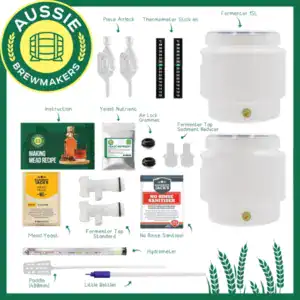
Unleash your inner Viking with our Mead Brewing Kit Large, the ultimate starter kit for crafting your own honey wine at home. Perfect for both beginners and seasoned brewers, this comprehensive kit includes everything you need to create up to 15 liters of smooth, delicious mead right in your kitchen. With easy-to-follow instructions and top-quality ingredients, you’ll be enjoying your homemade mead in no time.
What’s Included:
15-Litre Fermenter x 2: Spacious, durable, and easy to clean, designed for optimal fermentation.
Airlock & Grommet x 2: Ensures a perfect seal, allowing CO2 to escape while keeping your brew safe from contaminants.
No-Rinse Sanitizer Satchel: Quickly and effectively sanitize your equipment to ensure a clean brewing environment.
Two batch sizes
Our Best Mead Making Kit ($79.95) is built around a 5L glass demijohn — about seven 750ml bottles per batch. It’s the right size for a first attempt, for trialling a new honey, or for anyone who’d rather not commit a large volume of expensive honey to an experiment.
The Mead Brewing Kit Large ($135.00) steps up to 15L, roughly twenty bottles. Choose this one if you already know you like mead, or if you’re planning to age part of the batch — mead improves considerably over six to twelve months, so a bigger batch lets you drink some young and cellar the rest.
Both include the fermentation vessel, airlock and brewing accessories. Honey is not included, and that’s deliberate — the honey you choose is the single biggest influence on how your mead tastes, and most people want to pick their own.
What mead actually tastes like
It depends almost entirely on the honey. A light clover or yellow box honey gives you something delicate and floral. Leatherwood or a dark bush honey produces a far more assertive, almost caramelised character. Strength typically lands between 8% and 14% ABV depending on how much honey you use and how far the yeast takes it.
You can also make melomel by fermenting with fruit, or spiced metheglin with cinnamon, cloves or vanilla. Both use the same equipment.
It takes longer than beer
Worth knowing before you start. Beer is drinkable in two to four weeks. Mead ferments for four to six weeks and genuinely benefits from three to six months in the bottle — a young mead can taste harsh and yeasty in a way that resolves entirely with patience.
If you want something ready sooner, a beer, cider or ginger beer starter kit is the better first project.
Getting the recipe right
Our mead recipe guide walks through a straightforward 5L batch, covers the stages of fermentation, and explains racking to secondary. Read it before you buy honey — it’ll tell you how much you need.
Mead Making Questions
What people ask before brewing their first batch of honey mead.
For a 5L batch you’re looking at roughly 1.5–2kg of honey depending on how strong and how sweet you want the finished mead. The 15L kit needs proportionally more, around 4.5–6kg. Buying honey in bulk from a local apiarist is usually far cheaper than supermarket jars, and gives you a more interesting result. Check our mead recipe guide for exact quantities.
Wine yeast, not beer yeast. A champagne yeast like Lallemand EC-1118 is the reliable choice — it’s tolerant of high alcohol, ferments clean, and won’t fight you. Some brewers prefer a dedicated mead yeast for a fruitier result. You’ll also want yeast nutrient, because honey lacks the nitrogen yeast needs and a nutrient-starved mead ferments slowly and can develop off flavours. Browse our wine and mead yeasts.
Yes — the terms are interchangeable. Mead is fermented honey and water, which puts it closer to wine than beer in both method and strength. You’ll see it sold as honey wine in some places, and some traditional styles carbonate it, but it’s the same drink.
You can, but you’ll need a fermentation vessel, an airlock and bung, a sanitiser, a hydrometer to track fermentation, and a way to rack off the sediment. Buying those separately usually costs more than the kit and it’s easy to miss something — the hydrometer in particular, which is what tells you whether fermentation has actually finished before you bottle. Bottling early is the most common way to ruin a batch.